Enzymes

Author: Shuhan Yu
Editors: Linzi Yeung, Chloe Qian
Artist: Francesca Huang
Think about the last time you ate a meal; did you notice your body breaking down food into energy? Probably not. This process, known as digestion, depends entirely on enzymes–the tiny proteins that make life possible. Moreover, enzymes are specific proteins; they act as catalysts, accelerating chemical reactions without being consumed in the process. Some enzymes break down food, thus allowing your body to absorb nutrients, while others help build molecules needed for growth, repair, and overall function. You have enzymes in your organs, such as the stomach, pancreas, and intestines, as well as inside your cells. They work quietly but efficiently, ensuring your body can perform essential tasks every second of every day. Without enzymes, processes like digestion, energy production, and waste removal would slow dramatically, making normal life impossible.

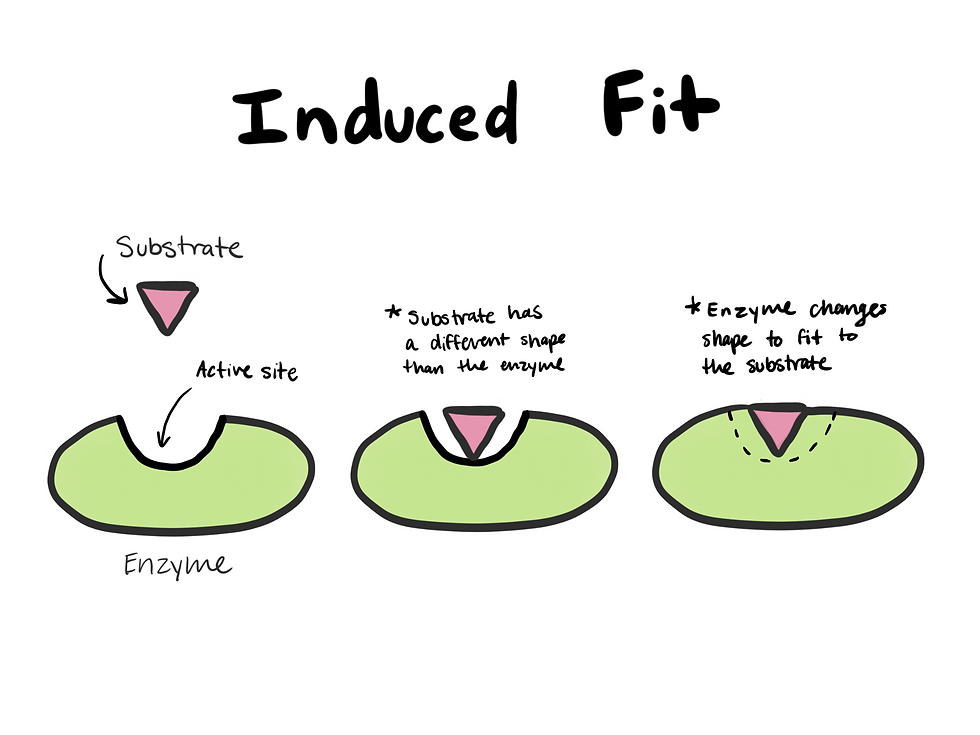
Enzymes play a critical role in digestion by breaking down carbohydrates, proteins, and fats into smaller molecules that can be used for energy production. One particular enzyme, amylase, in saliva converts starch into sugar. Another, protease, breaks proteins into amino acids, while lipase, in the pancreas, converts fats into fatty acids. Each enzyme works with specific molecules referred to as substrates, which fit into the enzyme’s active site like a key in a lock. Although in some cases, the enzyme changes shape slightly to improve the fit, allowing the reaction to happen quickly and accurately. Cofactors and coenzymes also assist in the chemical process. The first are inorganic helpers, such as metal ions like zinc, magnesium, or iron; the latter are organic, vitamin-derived molecules that bind to enzymes and aid in the transfer of chemical groups and electrons. Both are crucial for proper metabolic functions; thus, a balanced diet rich in vitamins and minerals, which supports your body’s enzyme activity, is important.

Enzymes also need the right conditions to work effectively. Most human enzymes perform best at normal body temperature–around 37 °C (98.6 °F). Extreme heat or cold can cause enzymes to lose their shape, a process known as denaturation, which prevents them from properly binding to their corresponding substrate and carrying out their intended function. Similarly, the pH of the environment also affects enzyme activity. For example, pepsin, an enzyme in the stomach, works best in acidic conditions. If your stomach acid is too low, changes in pepsin’s structure may manifest, thus slowing digestion. When enzyme activity drops, your body struggles. You might experience bloating, gas, fatigue, nutrient deficiencies, or digestive disorders. Doctors often check enzyme levels in your blood to detect issues with the liver, pancreas, or muscles. In some cases, medical conditions such as exocrine pancreatic insufficiency or lactose intolerance require enzyme supplements to help your body digest food. Even then, supplements should only be taken under a doctor’s supervision.
Enzymes aren’t just important inside your body; they have wide applications outside as well. Scientists and industries extract enzymes to create medicines, process foods, and formulate cleaning products. They rely on the same principles that govern enzymes in your body: speed, precision, and efficiency. Enzymes can convert substances, break down complex molecules, and produce valuable compounds quickly and accurately. In your own body, enzymes convert the food you eat into energy, build and repair cells, and remove waste products with efficacy. Even small changes in enzyme activity can affect your health, energy levels, and overall well-being. Life as you know it would be impossible without enzymes, and supporting their function through good nutrition, proper hydration, and healthy habits ensures your body continues to run smoothly every day.
Citations:
Robinson, Peter K. “Enzymes: Principles and Biotechnological Applications.” Essays in
Biochemistry, vol. 59, 2015, pp. 1–41. PubMed Central,
“Enzymes.” Cleveland Clinic, 12 May 2021, https://my.clevelandclinic.org/health/articles/21532-


Comments