Can you Really Rely on AI for Your Health?

Author: Vincent Guo
Editors: Ethan Tai, Jonathan Chen
Artist: Yahe Song
Many people have questioned whether artificial intelligence (AI) is a reliable source to use for your health related concerns and if it is trustworthy enough to ask questions like “What could these types of symptoms be?” or “How can I treat this illness?” Well, the short answer is yes and no. You could use AI in some scenarios, but you shouldn’t rely on it exclusively. There are benefits to using AI, but it also comes with risks.
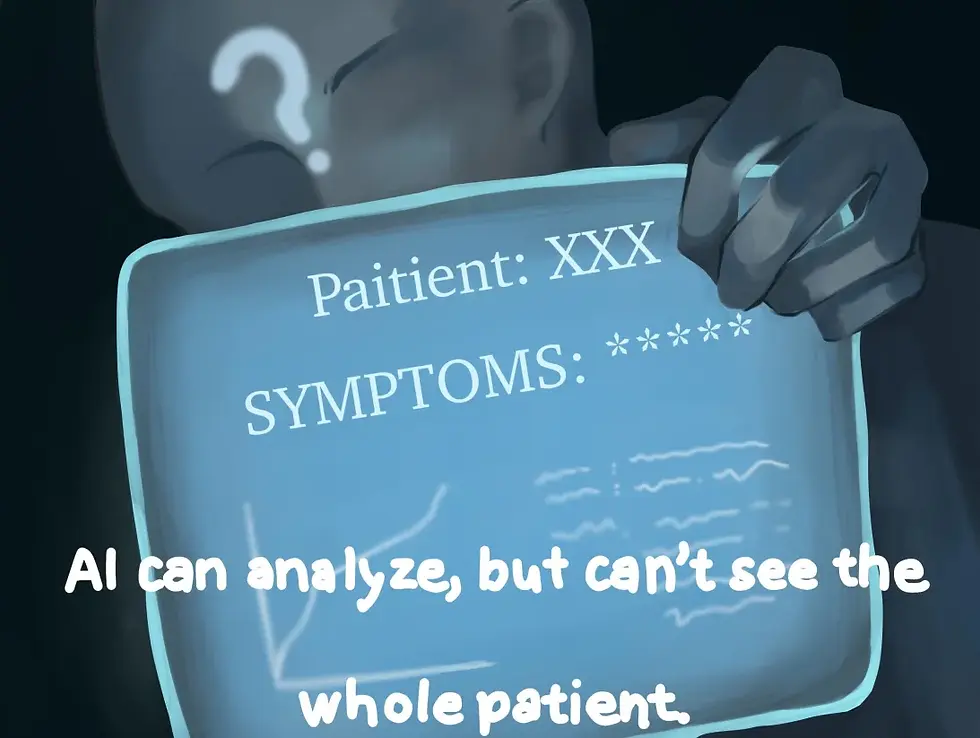
The use of AI for health is quite vast, and it is an excellent tool for getting information. For example, you can use it to shorten long paragraphs of information into smaller chunks. You can use it to better understand your symptoms and prepare questions for the doctor. There are also many applications of AI in hospitals. Currently, AI is being integrated into many different clinical settings, such as being used to look at X-rays, MRIs, and CT scans. It could help point out things like tumors or fractures that could’ve been missed by medical professionals. Although they are as accurate as experienced radiologists, they should only be used to assist them. The medical professional has the final say. When treating patients, there is a lot of data to write down and keep monitoring; this is where AI could be used to summarize that data, which gives the healthcare workers extra time to focus on other issues. There are AI tools that can serve as a reminder to take medicine and also monitor patient health, such as monitoring chronic conditions related to diabetes or hypertension, also known as high blood pressure. For conditions like diabetes, it is very important to monitor the patient’s blood sugar level, since a rise or drop in their level needs to be addressed quickly.

While there are many great things about how AI can be used by medical professionals, there are also many downsides. The main issues with using AI is its reliability and accuracy, as there is a chance that the AI could provide incorrect information. This can be caused by how it was programmed, misinterpreting the information incorrectly, or using an unreliable source and giving out false information. There are also times when AI just starts to make its own information. For example, if you read a book and forget some of the key details, you may ask an AI to summarize it. However, the AI might start making up things that never occurred in the book. If this happens in a medical scenario, it could delay the patient getting the proper treatment in the proper time period, threaten the patient's well-being, and possibly put their life in danger. AI could make the wrong diagnosis due to a lack of information, such as full patient history, physical examination, genetic background, and also their culture. This information is crucial and necessary for healthcare providers to make the correct diagnosis and treatment plan. Even when AI systems have access to the full patient history, physical examination, and other important information, there are concerns about data leaks and how secure their information is. That information is very private, and if the data isn't secure, that is a huge privacy issue.

There are also some ethical concerns to keep in mind, such as the data being biased. People are concerned about whether the AI will use data from diverse groups or demographic groups to make the diagnosis. This is a huge concern because without using data from different demographic groups, the medical professional may lose valuable information and possibly misdiagnose the patient. There is also the issue of responsibility if an accident occurs. If the AI makes a mistake, who would be held accountable: the person who programmed the AI or the healthcare providers?
There are pros and cons of AI use in medicine, like how there are two sides to a coin. AI should not be used to replace a healthcare provider, and should only be used to assist them. In the end, AI is reliable but only to a certain extent.
References:
Chustecki, M. (2024, November 18). Benefits and risks of AI in Health Care: Narrative Review.
Interactive journal of medical research. https://pmc.ncbi.nlm.nih.gov/articles/PMC11612599/
9, F. (2024, February 9). Should AI be used in health care? risks, regulations, ethics and benefits of
AI in medicine. American Medical Association. https://www.ama-assn.org/practice-
Doraiswamy, M., & Benioff, M. (2025, September 10). Ai is revolutionizing health care. but it can’t
replace your doctor. Time. https://time.com/7315960/ai-healthcare-murali-doraiswamy-marc- benioff-essay/
Powell, A. (2025, March 20). How ai is transforming medicine. Harvard Gazette.
Centers for Disease Control and Prevention. (2024, August 22). Health equity and ethical
considerations in using Artificial Intelligence in public health and medicine. Centers for Disease
Control and Prevention. https://www.cdc.gov/pcd/issues/2024/24_0245.htm


Comments